Thursday, November 17, 2011

Reaching the Impossible: Chad Hymas


We were so honored to have CSP, CPAE Hall of Fame Speaker, Chad Hymas speak at Meeker High School today. His message was sincere and he touched on so many subjects that apply to each and every one of our students. Be kind to each other, make good decisions, honor yourselves and others, don't judge others, respect people that are different than yourselves, include everyone, make "that phone call", give it your all, don't give up... What did YOU get from today's assembly?

For more information on Chad, visit any of these websites:

www.ChadHymas.com

YouTube

Twitter

Thank you, Chad Hymas, for sharing your amazing and touching story with us! You are truly an inspiration!

Tuesday, November 15, 2011

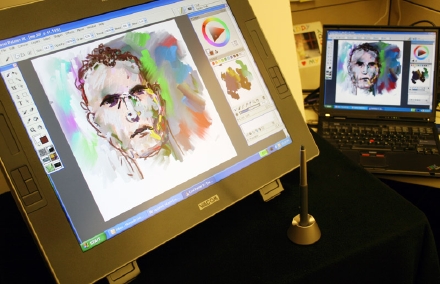
Computer Graphics: Wacom Tablet


For our Digital Painting Project we are using the super-dooper Wacom Tablet! Many creative professionals use the Wacom Tablet in their work. To learn more about the Wacom Tablet, visit their website: Wacom

Monday, November 14, 2011

Quote o' the Week

How it works:

Read the quotes below and write about how one (or more) applies to your life or how you can learn from it (10 points)

-OR-

Make a visual representation of a quote - drawing, painting, etc. (5 to 100 points depending on quality and effort)


The quotes:


"Gratitude is the best attitude."
~ Author Unknown

"Gratitude is the least of the virtues, but ingratitude is the worst of vices."
~ Thomas Fuller

"The only people with whom you should try to get even are those who have helped you."
~ John E. Southard

Thursday, November 10, 2011

Yearbook - Story Writing

What’s Your Story?

Analyze your spread for storytelling quality considering all aspects of coverage and content.

RELEVANCY
Is the story meaningful to readers?

INCLUSIVE:
Have you included guys and girls; all grade levels; different cultures; and at least one person not covered in the book elsewhere? Is there a sense of relationship developed?

INTERESTING: Does the story offer “something for everyone” angles to content such as family, friends, faith, entertainment, etc?

INFORMATIONAL: Do details date the experience specifically for this year? Have you included facts and figures?

INSIGHTFUL: Are there unique angles of the story that compel readers to see something new or from a different perspective?

INTERACTIVE: Does an element on the spread make the reader “do something” like answer a question or match up items?

REPORTING
Is the story documented with facts, figures and feelings answering the 5Ws and H?

Who, What, Where, Why, When & How!


Do the words and pictures harmonize to tell the story without repeating stories?

Does a primary/secondary headline package capture and keep readers’ attention with story highlights and cool words?

Does a single news feature or a combination of story packages present the story in an informative and entertaining way?

Do captions continue where the story of the photographs end giving readers the benefit of knowing the before/during/after of the pictured moments?

Does your collection of photos showcase the action, reaction, scrapbook moments and personality portraits of the activity or event story?

Have you captured the photo stories from single-subject, multi-subject and larger group perspectives?

If used, does artwork enhance the story with additional information and/or insights?

Wednesday, November 9, 2011

Photo Transfer & Mixed Media Steps

PHOTO TRANSFER


1. Spread an even layer of gel medium on a photocopy of your image.

2. Lay the image face down onto your canvas.

3. Rub a clean rib over the back of the photocopy.

4. With a clean and wet sponge, wet the back of the photocopy once.

5. Let the transfer dry overnight.

6. Gently rub the transfer with a wet sponge to peel away the paper. This may take several days. Be careful to not peel away the image.

PLEASE NOTE: Do NOT use images from the internet. Make sure you choose images that are clear and have contrast. Your artwork must have a narrative, focal point, symbolism and use the 2/3rds rule.


CREATING TEXTURE WITH MODELING PASTE


1. Take a palette knife and spread the modeling paste on top of your canvas.

2. Create desired texture.

3. Let the modeling paste dry before you paint.


TRANSPARENT PAINTING OR "WASHES"


If you want to create a hand-painted look over your photo transfer you can dilute the acrylic paint with water and paint over the transfer. The more water you add, the more the paint will appear like watercolor. You can also add paint, then put paper towels on top of the paint and pull off (see the red flowers for an example).


TRANSFERS USING TRANSFER PAPER
The horse in the picture below was traced using transfer paper. To use this technique you need transfer paper. If you will be tracing onto a light surface, use the black transfer paper. If you will be tracing onto a dark surface, use the white transfer paper.

1. Pick the image you will be tracing.

2. Lay the transfer paper, coated side down, onto your canvas.

3. Lay the image onto the the transfer paper.

4. Trace the image, outline only (no value/shading), with the end of a paintbrush or a pencil.

5. Remove and then paint over your lines.


THE FINAL MIXED MEDIA ARTWORK


Artwork by Miz Burnell
Copyright 2011


Artwork by Miz Burnell
Copyright 2011

Monday, November 7, 2011

Quote o' the Week

This week in our Pop Art lesson we discussed Jasper John's artwork. We see the flag every morning as we say the Pledge of Allegiance and yet, do we really SEE the flag? Do we contemplate it? We are often too caught up in other thoughts to really see what is around us. To really know, to observe, to appreciate, to understand. The artist observes, brings to light, forms ideas. That is why an artist's concept is so important. Your concept for your artwork is so important! Our quotes this week are about observing, seeing and imagination. I love these quotes!

How it works:

Read the quotes below and write about how one (or more) applies to your life or how you can learn from it (10 points)

-OR-

Make a visual representation of a quote - drawing, painting, etc. (5 to 100 points depending on quality and effort)


The quotes:

"I saw the angel in the marble and carved until I set him free."
~ Michelangelo

"A rock pile ceases to be a rock pile the moment a single man contemplates it, bearing within him the image of a cathedral."
~ Antoine de Saint-Exupéry, Flight to Arras, 1942

"I like nonsense, it wakes up the brain cells. Fantasy is a necessary ingredient in living, it's a way of looking at life through the wrong end of a telescope. Which is what I do, and that enables you to laugh at life's realities."
~ Theodore Geisel

"I paint objects as I think them, not as I see them."
~ Pablo Picasso

"Trust that little voice in your head that says "Wouldn't it be interesting if..." And then do it."
~ Duane Michals, "More Joy of Photography"

"The most beautiful thing we can experience is the mysterious. It is the source of all true art and science. He to whom the emotion is a stranger, who can no longer pause and stand wrapped in awe, is as good as dead; his eyes are closed."
~ Albert Einstein

Friday, November 4, 2011

All about Color

Hue: Another word for color.

Primary Colors: Colors that you have to "buy" (you cannot "make" by mixing). Red, Yellow and Blue.

Secondary Colors: Colors that are made from primary colors. Green, Orange and Violet (purple).

Complementary Colors: Colors opposite of each other on the color wheel. When next to each other they "pop". When mixed they create brown.

Red and green (think Christmas)
Blue and orange (think Broncos)
Yellow and purple (think Lakers)

Neutral Colors: Grays, browns, white and black.

Shades: A hue plus black.

Tints: A hue plus white. Pink, baby blue, peach...